How to Stop Deep Tech Startups From Losing Their IP at Wind-Down
This is Part 3 in a series on informal IP, aka “dark matter.” You can read Part 1 here and Part 2 here.
When a deep tech startup shuts down, most of its most valuable knowledge never makes it into the deal room. It lives in lab notebooks, Slack threads, and the heads of the two or three people who actually know why an experiment worked. Gliding Ant Ventures spent months studying this problem, and we landed on four coordinated fixes that could stop it from happening: better AI capture tools, stronger documentation habits, standardized wind-downs, and a non-profit library for donated IP.
The Real Risk Isn't the Patents, It's the People
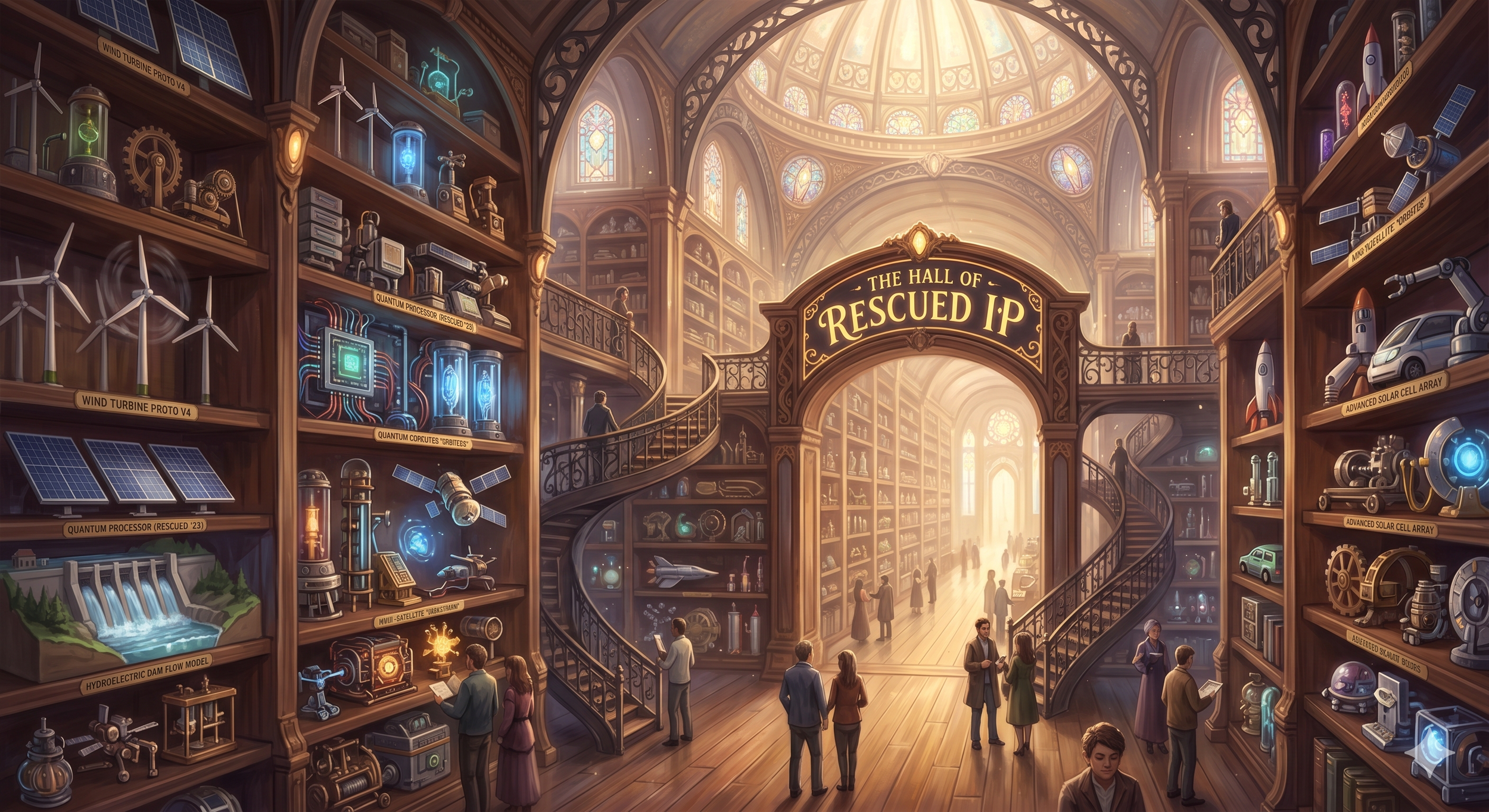
Every early-stage startup carries key person risk, the danger that losing one person could sink the whole company. In deep tech, that risk usually isn't the CEO. It's the person on the R&D team who has an intuitive feel for the technology that nobody else can quite replicate. When our partner Jared ran BlueDot Photonics, he and his co-founder were genuinely afraid of losing anyone on the team, precisely because that knowledge lived nowhere else.
We call this knowledge dark matter: the informal IP inside a startup, including lab notebooks, wiki pages, daily operating notes, facility designs, and the tacit sense of what does and doesn't work. Like its cosmological namesake, it makes up most of a company's real IP but is almost never accounted for. Our research drew on conversations with more than 150 people across the innovation ecosystem, as well as a survey of 25 founders and 5 investors who have collectively deployed over $3 billion in capital.
Four Ways to Rescue Informal IP
We landed on four interventions that, together, could keep dark matter from disappearing:
AI capture tools that annotate documentation, catalog know-how, and act as a Q&A interface for exit interviews and invention disclosures.
Data hygiene habits, SOPs, digital lab notebooks, and a quarterly process for extracting tacit knowledge are treated as core startup disciplines rather than busywork.
Standardized wind-downs, including postmortems and open-source frameworks, so that failed ventures leave something behind.
A non-profit IP library that assumes the cost and responsibility of preserving donated IP as a public good, as Cascade Climate does for enhanced rock weathering research.
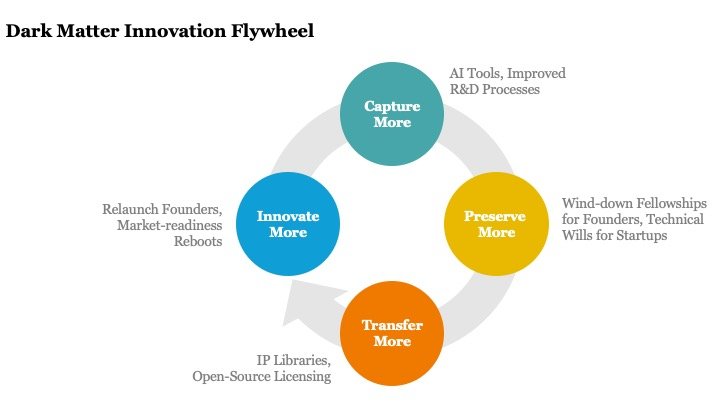
The dark matter flywheel: systematic capture, preservation, and transfer of knowledge from wind-downs creates an innovation accelerant for the next generation of deep tech founders.
Why Hasn't the Ecosystem Fixed This Already?
It's a classic collective action problem. Researchers, founders, investors, and lawyers all lose when informal IP disappears, but no single player can fix it alone. Building AI capture tools takes real capital from investors or philanthropists. Better documentation habits require founders to slow down and investors to accept the upfront cost. Standardizing wind-downs means law firms, founders, and investors rethinking legal frameworks together, and a non-profit library needs funders, founders, and a legal structure all pointed in the same direction.
Write the Technical Will Before You Need It
One of the more concrete fixes is something startups can adopt today: a technical will, a document created at formation or at the first major equity round that spells out what happens to the technology, including the option to open-source it, if the company winds down. Deciding this before a crisis hits means the team executes a plan instead of arguing over what's left. We walk through all four interventions in full, including how open source actually got its start in the auto industry a century before software, in the original article on Building for 2075.
FAQ
What is "dark matter" in a deep tech startup's IP portfolio?
Dark matter is the informal, undocumented IP inside a startup, including lab notebooks, wiki pages, daily operating notes, and the tacit knowledge team members carry about what works and what doesn't. It typically makes up most of a company's real intellectual property, yet it's rarely captured or valued the way patents are.
What is key person risk in a startup?
Key person risk is the danger that losing one specific team member, often not the CEO but whoever holds singular know-how about the technology, could threaten the company's future. In small deep tech teams, that risk can apply to anyone whose knowledge exists nowhere else.
What is a "technical will" for a startup?
A technical will is a document created at formation or at the first major equity investment that defines what happens to a startup's technology under different circumstances, including a wind-down, and can specify open-sourcing as a preferred outcome. It lets a team execute a plan rather than arguing over IP once the company is already failing.
What are the four ways to prevent deep tech IP from disappearing at wind-down?
The four interventions are building AI tools to capture tacit knowledge, developing shared data hygiene best practices, standardizing startup wind-downs with open-sourcing as an option, and creating a non-profit library to curate and preserve donated IP. Each requires a different mix of capital, ecosystem coordination, and legal innovation to work.