What Happens to a Startup's IP When the Company Fails?
This is Part 2 in a series on informal IP, aka “dark matter.” You can read Part 1 here.
When a startup shuts down, its formal intellectual property (patents, trademarks, and registered assets) usually sells for less than 2% of the capital invested in the company. The informal IP, meaning the know-how and hard-won experience built up over years, is lost completely in more than 60% of wind-downs. That second number is the one most founders never see coming.
What is "dark matter" in a startup?
Most founders have a box somewhere. It might be in the office or the garage. Inside are the legal documents, a hard drive backup, and a few souvenirs from years of work. But the box never contains the most valuable thing a company has built: the tacit knowledge in people's heads about what works and what does not.
We call this informal IP the "dark matter" of a startup. It is the unseen mix of know-how, messy notes, and team communications that accumulates over the years. You cannot point to it on a balance sheet, but it is often where the real value lives. When the team disperses, that value tends to evaporate within weeks.
Why does so much startup IP disappear?
We talked with over 150 people across the innovation ecosystem and surveyed founders and investors who have collectively deployed more than $3 billion in capital. We mapped eight typical wind-down paths and found that dark matter is mostly or entirely lost in over 60% of them. The destruction is rarely malicious. It is usually the result of competing priorities, tight cash, and decisions that have to happen fast.

This gem was found while clearing out the Beta Hatch offices — chaos indeed!
Here are six problems that keep causing the loss:
1. Chaos during the wind-down. Decisions get made under pressure, especially for perishable assets or anything with maintenance costs. An expired software subscription at one company we studied wiped out significant digital assets. Small mistakes, like a lost password, become permanent losses.
2. Tacit knowledge is the hardest to save. When key people leave, the intuition goes with them. One materials startup negotiated a sale but found that the most valuable employee know-how had already left, leaving only lab notebooks behind.
3. Current tools do not capture it well. Only about a quarter of the founders we surveyed were interested in acquiring R&D notebooks or company wikis from a failed competitor. They saw the value but felt the effort to extract anything useful was too high.
4. The financial incentives are misaligned. About 65% of founders overestimate the value of their IP, sometimes by a factor of 10. That distorted view leads to mothballing, which is the outcome for roughly a third of wind-downs.
5. There is no playbook for open-sourcing it. Releasing informal IP to the public occurs less than 5% of the time, usually only when ownership is straightforward and a passionate technologist remains involved.
6. Without a buyer, there is nowhere for it to go. Storage costs stay constant while the asset's value erodes, so deletion becomes the easy default.
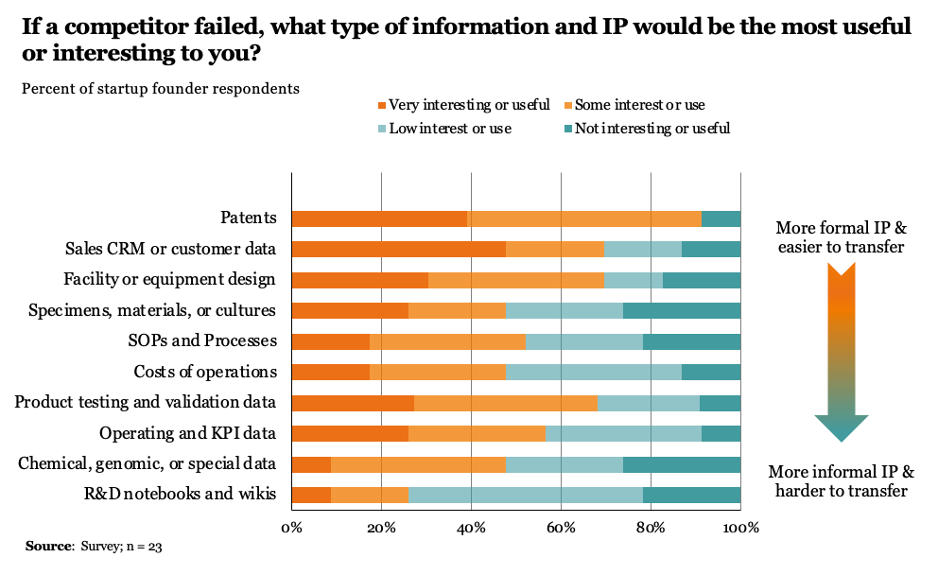
Survey results show greater interest or perceived value in more formal, structured IP, and less interest in informal, less tangible, and harder-to-transfer IP. Notably, interest varied across sectors and industries. Source: Gliding Ant Venture research.
Why this matters for founders and investors
Think of dark matter like fresh produce. It has a short shelf life. The longer a transaction drags out, the less anyone can recover. Technology that took years and millions to develop can be erased with a few clicks, and in many cases, it is.
The encouraging part is that these problems share common roots: uncertainty, misaligned incentives, and technical gaps. None of them looks insurmountable once you can name them. If you have been through a shutdown yourself, you have probably watched some version of this happen, and your story is part of how we fix it.
For the full breakdown, including the eight wind-down paths and detailed case studies from companies like Beta Hatch, BlueDot Photonics, and Makani, read the original article on our Substack.
Frequently Asked Questions
What percentage of a startup's IP value is recovered when it fails? In about 60% of wind-downs that find a buyer for the formal IP, the sale represents less than 2% of the capital invested in the company. In one case study, a company that raised roughly $30 million sold its IP for only 0.1% of that amount.
What is informal IP, or "dark matter," in a startup? Informal IP is the tacit knowledge, know-how, unstructured notes, and team communications built up over years of work. It is not registered or documented like patents, which makes it the hardest asset to capture and the easiest to lose when a team disbands.
Why is startup know-how lost during a shutdown? The most common causes are chaos and time pressure during the wind-down, key employees leaving with knowledge in their heads, tools that fail to capture informal IP, misaligned financial incentives, no playbook for open-sourcing, and the absence of any buyer or repository to receive it.
Can a failed startup's IP be open-sourced instead of sold? Yes, but it is rare, happening less than 5% of the time. It tends to work only when ownership is simple, the founders have an open-source mindset, and a passionate technologist stays engaged through the wind-down.